Lao Tzu

"A good traveler has no fixed plans and is not intent on arriving.” – Lao Tzu


Monday, January 28, 2013

Women in Combat— This is Equality?


This is no joke, and yet the Facebook website proudly displaying this poster, a website dedicated to ground troops, received 629 “Likes” and 149 “Shares,” as of this writing, alongside a number of comments taking it as a joke. One comment suggested a backlash against women in combat to come, and I won’t be surprised if that backlash comes in the form of increased rapes, adding to the present epidemic of sexual assaults in the military. But let’s be clear: it’s not women in combat that will be responsible. The responsibility will be with men in combat with antiquated, macho, misogynistic attitudes, and a military system that bolsters them.

Women who join the military have another think coming if they think the military values equality. As it is in reality, the military is the last place a woman can expect to be treated as an equal. 

http://www.cbsnews.com/8301-18563_162-57566084/pentagon-battling-military-rape-epidemic/

http://www.newsday.com/opinion/oped/bernard-will-the-military-finally-address-the-epidemic-of-sexual-assault-1.4504483

Friday, November 23, 2012

Beauty or Truth: Will I be Beautiful, or True?


 A beautiful person I know posted the following article at Facebook. My response, too long and contrary for Facebook, follows this brief quote:

I've started telling my daughters I'm beautiful...
There are a lot of people like me. Women who know things. Women who have seen things. Women with diseases in their livers. There are a lot of women with scars on their arms and words that carry themselves like sparrows. There are women who were too big for this town, who had their backs bent carrying things like religion and a history that originated somewhere in the crook of a branch that extended over a stream. A place where a patch of the sky was visible through the leaves, where a little girl let her bare leg dangle too far down.

There are a lot of people like me, because we're all the same. We're all blood and electricity. We're lonely under the gaze of god. We're all wet with dew and swallowing hard against DO THIS, CONSUME, SHUT UP and BE AFRAID to die.

All of you women with lines on your brow, with cracks between your fingers… it's been a long winter. All of you, you are beautiful and so am I.”


And now for some stinkin’ thinkin’ because that’s what I’m good at and what’s beautiful about me.

Well, I admit the article brought a tear to the eye on first go ‘round, but then, because “denial ain't just a river in Egypt,” I decided it was nothing but Stuart Smalley on estrogen: “I'm good enough, I'm smart enough, and, doggonit, I’m beautiful!

Right: So we may not make the same money men make doing the same job; we may not have an Equal Rights Amendment yet; maybe glass ceilings still exist in two-thirds of companies across America; and perhaps some of us have scars across our chests where breasts used to be, because some big-Pharma poophead decided menopause needed a pill— but not to fret, we can always tell ourselves we’re beautiful. And that’s because, to quote another SNL fave, Fernando, “It is better to look good than to feel good."  Except that in this case, looking good IS feeling good, and if you can lie to yourself, you’re all the more appealing to the rest of us. That way we don’t have to think about all those other pesky realities, or feel guilty for not doing so; but, especially, that way we don’t have to kill you for being negative.

In womanland these days, the ultimate sin is negativity. You may imagine when you admit to a flaw you’re going to earn points for humility, honesty and transparency, but, sorry, it doesn’t work that way. Instead, you’re going to lose points: In this world, honesty equals negativity, and negative people just “bring us down.” That is to say, if you admit to not exactly being Perfection Unlimited, but, rather, that for you the beauty train long ago left the station, then everybody else will risk facing their own imperfections. After all, we’re holding on by the most tentative of threads to a self-esteem scratched into the wall of second-class citizenship. Unless we bolster ourselves with phony affirmations, thinking to outsmart the opposition, we’ll be unable to manage. But that way we tempt the evil eye, only to drop to the ground like Wile E. Coyote, having outsmarted ourselves instead.

Of course, yes, the “beautiful” word means beauty in spirit and deed. But why lie about that too? Sometimes I am not beautiful in that sense either. I’d say it’s better to feel good despite our imperfections, than to pretend we’re perfect. I’d say the author’s daughters would be better off hearing, “Mommy’s plump and saggy, sometimes cranky and complaining, but being perfect is not something humans do so well. What’s beautiful is to know that real perfection is always flawed, and that “beauty is truth, truth beauty,” as a wise poet named John Keats once wrote."

Beauty is so central to humans’ most cherished beliefs and pursuits, that Keats’s forceful lines seem to challenge important aspects of our very selves. Once the reader moves beyond this reaction, though, it becomes possible to see that Keats’s truth is liberating. If humans no longer need to strive to create the perfect beautiful form in whatever medium, then it frees them to be imperfect. Imperfection, in turn, liberates humans to make and remake art, and to recognize that one form dies with each individual death, and is then born again with each new birth– a common theme in poetry from the Romantic period. Bloom and Trilling refer to this realization as Keats’s “gift of tragic acceptance” (495), which the poet hands to the reader and urges him or her to accept and then contemplate. — http://www.articlemyriad.com/analysis-ode-grecian-urn-keats/


My own mother was Vivian-Leigh-beautiful, or as beautiful as any movie star I've ever seen. But she never felt the need to remind me of it. Instead, she seemed wholly unaware of her beauty, and I remember the advice she gave me once when I was in high school and getting ready for a party: "Fix yourself up, but then forget all about yourself once you get there."  I think her example served us far better than an "I am beautiful" attitude would have.  In her case, the truth was self-evident; to say more than that would have been bragging.

Monday, October 29, 2012

Discussion of "Killing Us Softly" Talk by Jean Kilbourne

 (This is part of a general discussion at Hartmann's forum on the objectification of women.)

http://thoughtmaybe.com/advertising-and-the-image-of-women/


Zenzoe wrote:
I could have used the video in my conversation with D_NATURED.  She makes lots of points that are relevant to that conversation about "tight young ass," "pussy," and the entire subject of the sexual objectification of women and girls; and in particular the influence advertising and media have on shaping and creating female sexual objectification as if it's normal. Her point that sex is both more important and less important than the media suggests is something I'd like to discuss further, given more time. Also, how the objectification of women in advertising correlates with violence against women.  That's important too, obviously.
D_NATURED wrote:
The video is utterly irrelevant to our conversation, Z. First of all, I've never advocated violence against women.
Zenzoe wrote:
Of course you don’t, and never did, advocate violence against women. But that you, in particular, are not violent toward women, nor do you advocate it, nor do you even ignore it as an issue, does not mean that sexist advertising does not correlate with violence against women.
Still, because I mentioned you and the terms you have used in the same paragraph where, at the end, I mention how advertising correlates with VAW, perhaps you felt the sting of yourself being associated with such. I’m sorry if such clumsy juxtaposition of words and ideas set you against the video from the get-go. I think, if you could bring yourself to take a second look at it, you might come away with a different impression. To my mind, she manages to give us the forest despite the trees, if you will: She gives us an insight about our own culture, one that is only possible if you stand far back and think critically about the culture she's showing you.
Thus, I disagree that the video is “utterly irrelevant to our conversation.” And by “our conversation” I don’t mean you, D., personally. I’m talking about the objectification of women generally. It’s only coincidence that you happened to defend the use of A.’s term “tight young ass,” but I understand your defense, and your attitude, and I accept that you don’t see such objectification as toxic in any way.
We have simply used such verbiage to move on to a more general discussion about our culture and its objectification of women. Please don’t take it as a personal attack. What we see in advertising is who we are as a distinct culture, one with ideals and messages wholly specific to ourselves as a society. It’s important to look at that objectively, but I think you know that.
D_NATURED wrote:
Secondly, the desire to have sex with attractive women pre-existed advertising and rightfully so. Sex is a biological necessity, advertising is a capitalist one. The only question is whether or not any woman feels she needs to live up to the ideal. That's a struggle to which many women are immune. Advertising merely attempts to tell us WHAT is "attractive" (and I agree, by the way, that much of it is impossible to attain, for the average woman), and is often in contrast to what nature would require.
Zenzoe wrote:
Well, here I have to remind you that “the ideal” is our culture’s ideal, and not the multiple ideals of femininity as manifested in various cultures around the world historically. That’s the understanding one needs to adopt while viewing the video. Behind the discussion about advertising must be the recognition of, the knowledge of, other cultures, and even our own culture’s varied and evolving notions of the ideal feminine.

You may recall that in ancient China the ideal of femininity had women binding their feet to conform to that culture’s male preferences. http://en.wikipedia.org/wiki/Foot_binding  In other cultures, a long neck on a woman signifies the feminine ideal, and so the women wear neck rings to elongate their necks.  In European cultures, hairy armpits are feminine, but here they're not.  In Peter Paul Ruben’s day, the heftier female was the ideal, and in that culture and other cultures our skinny ideal would have provoked revulsion and concern.

Remember Marilyn Monroe? (how could we forget?) Simone Signoret, the author, said Marilyn, in her off-camera life, rarely dressed in what she described as her “Marilyn getup.” There’s an anecdote where once Marilyn and two friends were walking through the streets of New York and Marilyn turned to her friends and said, “Do you want me to be her?” and then she took on the M.M. personality, and suddenly strangers on the street started to recognize her.

So there you have what some people refer to as the “female impersonation” that women have had to adopt to conform to male preferences within our own patriarchal culture. And we are still a patriarchal culture, D., in case you haven’t noticed.

Recently, I watched a favorite movie of mine from the 60’s again, a French movie that received an Academy Award for Best Foreign Film: A Man and a Woman. http://en.wikipedia.org/wiki/A_Man_and_a_Woman  It was a bit of a shock, however, to notice in the observant eyes of my 2012 perspective what I hadn’t noticed back in the mid-60s when I didn’t have the distance required to see this clearly: Anouk Aimee’s (female lead) tamped-down, shy portrayal of a woman (not portrayal of a shy woman), that is, her female impersonation. In her own way, Anouk produced an act exactly comparable to the Marilyn act—a feminine ideal for her times, a lá French and not so funny, one designed not to threaten males with female self-assertion, or bold, overt intelligence or gumption.

You have to understand, though, I’ve had the exhilarating experience of being exposed to portrayals of a more liberated femininity by some of our current American actresses. For example, Mary McCormack’s portrayal of U.S. Federal Marshal, Mary Shannon, in the TV series In Plain Sight. There, you may see blond and gorgeous, but you’re also going to have to contend with a smart-mouth, feminist, dry-wit, mocking and utterly not inclined toward the use of feminine wiles as leverage, unless for conscious sarcastic or ironical effect. I cannot tell you how refreshing it is to witness such a violation of the stereotype. 

D_NATURED wrote:
The vast majority of those ads appeared to be the kind found in women's magazines, though, which implies that women are equal consumers of and participants in their own objectification. Could that be because women need to know what IS attractive, so they can fulfill their own natural desire to be pursued by men for the same ultimate purpose as those pursuing? Is the assumption of mine that women want to be pursued a media suggestion? Can you blame men for what sells to everyone? If enough women object to what the ads are saying, will the market not respond?

During her speech, the camera panned out to an audience full of women in dresses and make up and jewelry. I suggest they weren't dressed by their husbands and boy friends that morning but, ultimately, by their mothers at childhood. Do you see where I'm going with this?

Zenzoe wrote:
Of course women are “equal consumers of and participants in their own objectification!” That’s the power of advertising. If it didn’t work on women, it wouldn’t be used by the men and women —advertisers— who consciously or unconsciously wish to demean women to sell products within this patriarchal, misogynistic culture.

And what IS attractive, again, is wholly determined by this culture at a very specific time and location within the history of human culture. What IS attractive, D., is determined by a vicious cycle of indoctrination and response, of wish, fantasy, and conformity.
The Barbie Doll didn’t evolve out of an empty context, after all. Barbie does not bear witness to a gender-neutral, liberated and equal society; just the opposite. It evolved not because of who and what we women really are, but who and what the chauvinist mind of capitalism and consumerism has projected as an ideal from its own perverted ideology. 

D_NATURED wrote:
I have no problem with recognizing the way we are manipulated by the media so that we can examine our own motivations and biases. Let us not ignore that some of our biases can not be intellectualized away or blamed on male oppression alone. I find it hard to believe that, even in Sweden, when a girl with an exceptional ass walks by, the men there do not care to look.
Zenzoe wrote:
I don’t know why you assume that (1) I think men are not biologically sexual and not sexually attracted to attractive women, and, (2), I blame all of this on male oppression, and, (3) that Sweden is not part of modern Western civilization, and (4) that I conflate men’s looking with men objectifying women. Sheesh, D., can you give me a break here? There’s a big difference between the two, and I wish you could see that. To look and enjoy is not necessarily to objectify. ;-)

D_NATURED wrote:
Besides, with all of these women on this planet that are not poreless size zeroes with perfect bone structure and giant tits, there is still an imperfect man who loves them. The fact that my wife, for instance, does not fit that ideal does not diminish my passion for her. She is still in possession of all of the things that make a woman sexually attractive as well as other intangibles. No ad can convince me that she does not deserve my love.

Zenzoe wrote:
Again, “poreless size zeroes with perfect bone structure and giant tits,” (and add to that unnaturally and dangerously thin), if it is an “ideal,” it is an ideal constructed within the context of a patriarchal, consumerist, sexist society; it is not an absolute, consistent-across-all-cultures ideal (thus, men and women are not wired biologically to love it). And furthermore, to address the issue of violence against women, it is an ideal that has dire consequences for girls and women. I first would suggest that even girls who starve themselves to the point of anorexia to live up to the ideal have had their self-esteem violated; the society that promotes the “ideal” of thinness also commits violence against women.

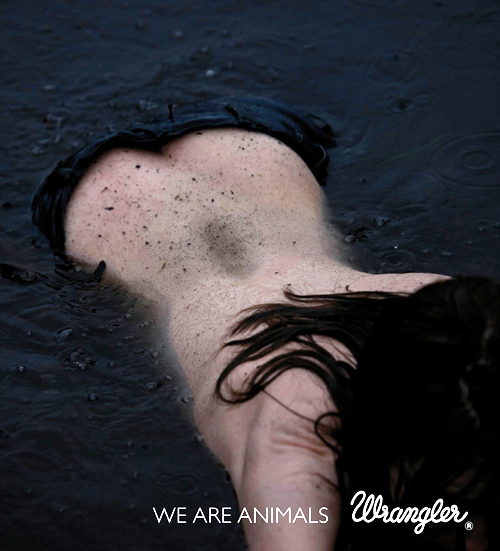
But let’s not pretend that consistent images in the media —and I absolutely disagree with the suggestion that the majority misogynistic advertising occurs in women’s magazines— of all the varied ways in which women can be degraded and even presented as prey, will not contribute to male violence against women. Consider Wrangler’s “We are Animals” ad campaign (Wrangler ads are found everywhere). http://www.ozonweb.com/en/wp-content/uploads/2009/07/wrangleranimals2.jpg http://thesocietypages.org/socimages/files/2008/08/wranglerad2.png 
 
So, there you see the notion of “we are animals,” not as a celebration of our mutual, erotic enjoyment within a context of sensuality and pleasure, but as a promotion of men as killers and women as prey; or men as killing animals and women as their dead prey. (and to think that ad campaign won all sorts of awards!) How much of this stuff, D., do you think springs naturally from the male psyche, rather than from the psyche of our deeply sick society?

And what makes you think images of that sort don’t register on the minds of less-ethical men than yourself, granting permission to them to violate women in the most horrific ways?

It’s wonderful that you’re able to rise above this crap. It’s great that you manage a fulfilling relationship with a real woman, that you’re not a superficial man who treats his wife as an object designed for his purposes alone. But your particular, individual case does not deny the truth the video presents, nor does it allow us to pretend that women and their objectification is not damaging to us all.

Sunday, October 7, 2012

The Fetus: A Person or Something Else Entirely?

 We're discussing abortion over at thomhartmann.com again. Here's a sampling:


D_NATURED: If you want to know what the fetus "is", ask the woman who owns it. I view it, by default, indifferently because I have already decided that I absolutely cannot be indifferent to the suffering of women. If I ever grew a pre-person inside me, I would expect the same pro-human "bias" from any other human, male of female.

Zenzoë: I'm with you on all of that, especially, "If you want to know what the fetus 'is', ask the woman who owns it."

For the woman who wants to bring a child into the world, being pregnant is worth the discomfort, the risk, the added pressures and responsibilities, the financial burden, the weight gain, the nausea, the exhaustion, the stretch marks, the hemorrhoids, the backache, and every other misery, including being kicked in the ribs every other minute.  For the woman who wants to be pregnant, her fetus is her baby, her growing and developing child whom she treasures and welcomes with her whole being.

For the woman who does not want to bring a child into the world —perhaps another child to add to an already burdened household— being pregnant conjures up any number of terrifying metaphors. I'm sure being pregnant against one's will might be tantamount to having a cancer growing within, an alien growth with the potential to bring disaster to every area of life.  This is especially true, I imagine, if her pregnancy resulted from rape, and she has been denied access to abortion. In that case, the fetus, though innocent of the crime, might reasonably be perceived and felt as Intruder, the devil's spawn, taking up residence inside one's most sacred and intimate space, and turning one's life bleak and unbearably anguished. For the woman who has not planned her pregnancy, the fetus is not a Who but a What, and that What has no potential whatsoever, other than doom.

If you think I exaggerate, remember this: We know the dreaded prospect of bringing such an unwanted pregnancy to term and suffering the fate of motherhood on those terms drives women to DIY abortion with coat hangers, or to back-alley abortionists, resulting in death, worldwide, to the tune of 68,000 annually. That some women CHOOSE to accept their unwanted pregnancy and mother the child regardless does not change the reality that tens of thousands of women each year will risk their lives to be free of an unwanted pregnancy. Pregnancy is serious business, and no man dare shame women for wanting safe, legal and easily accessed abortion.

D_NATURED:  Right, and the anti-human, pro-fetus people don't care about any of that. They only count dead fetuses. If women suffer or die from botched DIY abortions or if other actual, living babies die from lack of resources, who cares? The fetophiles are on a mindless mission to protect "the most powerless among us". No shit, they actually say things like that. There was even a pro-life commercial during the debate where such rhetoric was used.

The most powerless among us are not fetuses. Hell, fetuses aren't even among us. They are only "among" one person at all times and that is their host. We are unable to "protect" them without protecting women first. But you know that already. It is only those who believe they are the hands of god who give themselves the authority to ignore so many truths in their quest for fetal viability. In my humble (or not so humble) opinion, they should concern themselves with human viability, and population control and human rights are key to that very thing.


Friday, October 5, 2012

Notes While Clearing Out the Garage

“The strangeness of Time. Not in its passing, which can seem infinite, like a tunnel whose end you can't see, whose beginning you've forgotten, but in the sudden realization that something finite has passed, and is irretrievable.”  —Joyce Carol Oates


I’ve been clearing out the garage this week. It’s taking longer than it should, because I keep coming across old writings and art work, and all kinds of letters from family, and notes and cards from people I haven’t thought about for years, stuff I never had the gumption to throw out before now. Every now and then I find something especially moving, a letter for example, that originally meant little to me but now sends a pang of nostalgia and longing for that person. But then I’ll find a card from some idiot I’d dated, realize who the real idiot was —me— and, with gratitude for the better angels who rescued me from that one, throw the thing in recycling. What’s the cliché? “A trip down memory lane?” That’s exactly it.

One of the papers I came across was a printout I’d made off of some website (now “not found” and author unknown), a paper on stress. I had highlighted a number of paragraphs within it, including this one:

“According to Dr. William Fry, a five-year-old laughs more than 400 times a day and an adult laughs less than 14 times per day. A child also has 18-20 different facial expressions and adults only have four (LaRoche, 1998). Children are told to ‘get serious’ and ‘stop acting foolishly,’ so by the time that they are adults, they have gradually stopped laughing.”

That’s for starters.

Next, that first evening of dealing with garage treasures and trash I read a lovely essay in this month's The Sun magazine by Karen Vogel called, The First Year.  It was about her life on a farm in Canada with her husband and new baby boy. I hope it’s okay if I quote from it:

“A few weeks after the cows returned to the fields, it became clear that Aleksy, who was waking up to kick his mattress and practice rolling and who no longer cuddled sweetly, needed to move to his own room. The times when he could sleep next to me like a velvety hot-water bottle were gone. I frowned as my husband took apart the crib and reassembled it in the adjacent room. Aside from looking around excitedly at the new contours of the walls and becoming absorbed in an entirely new ceiling, Aleksy seemed utterly unaffected by the change. I reminded myself of how nice it would be not to have to sneak around my own room at night, to have at least one thing back the way it had been before.
    But instead of feeling like a comforting return to normal, the room without Alexsy’s crib seemed eerie and desolate. The furniture was still displaced where the crib had been, and the drapes had been taken down to use for Aleksy’s windows, so the moon poured in, bathing the walls and the carpet in its steely glow. Fred [dog], who had taken to sleeping in the den-like confines underneath the crib, wandered about before choosing a random patch of floor to lie down on. I felt as a child does for a balloon suddenly sucked away in the wind: a raw, sinking sadness. Aleksy would always change, would always move, would always be farther away.”

Then, the morning after reading the article, I woke from a complex dream, most of which I’ve lost to the fog that surrounds my dreams once I wake fully.  I can still remember parts of it, though, enough to make it relevant here.

In the dream, I am in a strange city, alone, touring, though it feels more purposeful than that as I try to remember. Somewhere along the path of this dream-adventure, I see a child of about three years outside on a sidewalk, playing by herself in front of a shop; the child appears to be lost, or unattended. I wait to see if the parents return, but they don’t, and so I decide to take her with me inside one of the buildings, a sort of mall, in hopes of finding someone who knows the child and can help.

The interior of the building is strange, naturally, with tiny rooms and complex corridors, crowded with all sorts of bizarre goings on, business and arty types going from here to there, seemingly unaware of my presence. At a certain point, after moving from room to room, I look up. I am in a long, narrow hall that has an infinitely high ceiling, and I notice that a circus of amazing, colorful objects is playing above me, objects suspended on strings or wires, objects which change, grow and expand, then contract, twirl and and dance as though imbued with living cells. It could be an underwater scene; but it’s not. It's alive, but like nothing I've known or have ever seen.

As I watch this performance playing above me, a grieving sadness moves over me and tears well up and stream down my cheeks.

I'm thinking, Why? Why do these "creatures" feel like loss?

That’s when I realize I am no longer holding the hand of the child. She is gone. I have lost her. I search in panic everywhere, moving from room to room, calling out, encountering people and situations here and there, but never finding her again.

As I woke from my dream that morning, I remembered someone in the dream coming up to me with concern for my tears. She seemed to know right away what it was all about. She said, “It’s the movement—all the changes, changes that mean loss, growth and moving forward simultaneously; it’s a message of change, a forever living change that is at once tragic, natural and right.”

It was then that I realized the grief was about my own babies too, grown now, changed, having moved on into adulthood and lives of their own, families of their own. I know they can do without me very well, thank you very much. I know it’s right and proper, but damn, it’s tough. Gradually over the years, one step at a time, I let them go. No, I can’t go back, and I’m glad to be relieved of the pressures of raising babies and small children; and yet I miss the intense, interdependent connection, the “you belong to me.” They’ve declared their independence —thank goodness— but, regardless, here I remain, Mother, even though the irretrievable remains too, in remembrance.

That’s why any day they need me is a wonderful day.

And the child in the dream was myself, my own changes, my having lost the child’s inclination to laugh 400 times a day, and being relegated to my four facial expressions— disapproving, skeptical, worried, and, well, defying all scientific expectations to the contrary, ridiculously, helplessly amused.

Monday, August 6, 2012

Notes from the "'Women's Issues' are 'Side Issues'" Thread at Thomhartmann.com

 "DITTO! If you leave, you let them win! And since when did this forum become for the purpose of wrangling with obstructionists anyway? That's why they're obstructionists: they are here to get in the way of a forum meant for a think-tank like environment for progressives, etc. to share ideas and information. What's really sad is to observe how often the obstructionists' tactic works: they know that their mere presence is enough to raise the hackles of us progressives here and make us want to take them on. And it is hard to ignore them after all: they know how to flood a thread and the board itself. So it takes some work to maintain the space, but people here (including myself), if they want to spend the effort, in my opinion need to spend more time debating which ideas are better, sussing out where we agree and disagree, how we can compromise if necessary and what kind of agenda we might look for, how to assess Obama and the democrats, which groups and individuals are doing good work, etc." —Nimblecivet

 Well, Nimblecivet, I was going to let you have the last word here, but no, I’m ba-aa-aack... :-)

Needless to say, I agree with the spirit of your comment, with its advocacy for hanging in there on behalf of the “think-tank like environment for progressives,” even though I personally often come here just to schmooze with simpaticos and defend my worldview against the not-so-simpaticos. Nevertheless, I did think it was good of you to add your “DITTO,” and encourage Ulysses to stay.

I understand Ulysses’ reaction to the rules-enforcement edict, as spelled out by Polycarp2, as much as I also understand the need for certain civil parameters, which might discourage real abuse, bullying, and the degradation of this forum away from the thinking environment you’d like to see.  But I understand, because I haven’t seen anything from any of us that would warrant banning. Instead, I’ve seen disputes that to my mind can only be categorized as either salubrious, educational, or funny, and any reactions to any nonsense always seemed warranted to me.

Seriously, though, the rules enforcement edict ruffled my sense of liberty, perhaps not as strongly as it did for Ulysses, but for sure. I don’t know how U. would speak to this, but for me it asks me to tell lies and to believe something about myself that is untrue, i.e., that I am devoid of hostility, and disgust, and aggression, and anger, and that I am only capable of confronting BS with silence, the kind of silence that I and my sex have been told is my/our only recourse in the face of injustice and wrongheaded belief.  For what is the moderated response, if not silence, when the vexation demands a merciless, unequivocal repudiation?  Speaking less formally, to be nice in the face of crap is to be stupid and enslaved twice, isn’t it?

Well, these thoughts are wasted on those who have been indoctrinated in the establishments of authority. It’s as though the concept of peace has evolved into a tyranny of quiet acquiescence.  Is that what peace is all about?  If so, I want none of it.

[Comment #1307, page 27]